


02 Dec Roppel 2017
On December 2nd, 2017, the world’s longest cave got a little bit longer. The Roppel 2017 Sump Exploration Team discovered and surveyed new passage, extending under South Toohey Ridge through the Logsdon River Sump. This achievement was made possible through the efforts of a host of cavers and scientist working on this sump exploration project started over 30 years ago.
Mammoth Cave National Preserve is a World Heritage site near Bowling Green Kentucky with evidence of use by man dating back 4000 years. World renowned for many aspects of its geology and history but without a doubt it is best known for the distinction of the longest mapped cave in the entire world. Its longer by half than its next closet competitor. To date, as announced at the Cave Research Foundation’s annual meeting in October, the length of surveyed passage in Mammoth is over 430 miles. To put that into perspective, the second longest mapped cave system in the world is Sistema Sac Actun (Nohoch Nah Chich) in Quintana Roo, Mexico. At 208 miles, Sac Actum is mostly all underwater. The second longest dry cave is Jewel Cave in Custer South Dakota at 182 miles and the longest dry cave outside the USA, Optymistychna, in the Ukraine is number 6 on the list at 147 miles.
The state of Kentucky is underpinned with karst (limestone) and driving across the plateau the sinkhole karst plain is evident in the many depressions and swales. While Tennessee has the most “dry” caves, Kentucky has some of the longest and at one time, 14 of the longest caves in the world were found in KY. Another interesting fact is that the ninth longest cave in the world is the Fisher Ridge Cave System and the known passage lies less than 2 miles east of the Mammoth Cave Preserve boundary. It’s a “well known secret” that some of the passage in Fisher Ridge is mere meters away from passages in the Mammoth system. It is most likely that these 2 cave systems connect, but to date, no one has made the connection. It’s also a “known secret” that the cavers working on the Fisher Ridge system do not want it connected to Mammoth as they will lose their place on the longest cave list because Fisher Ridge would officially become part of the larger Mammoth System. (Project cavers that spend their lives mapping caves can be a little “possessive”)
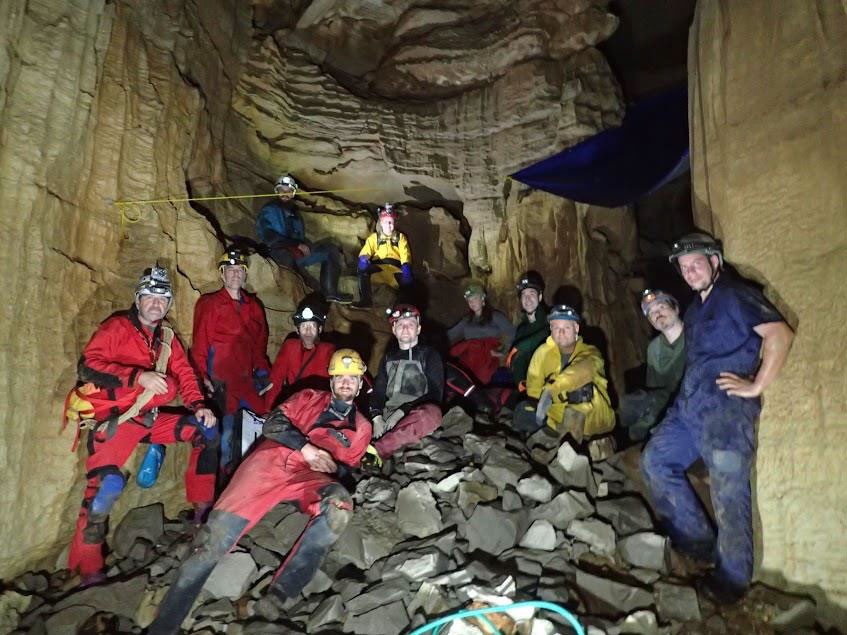
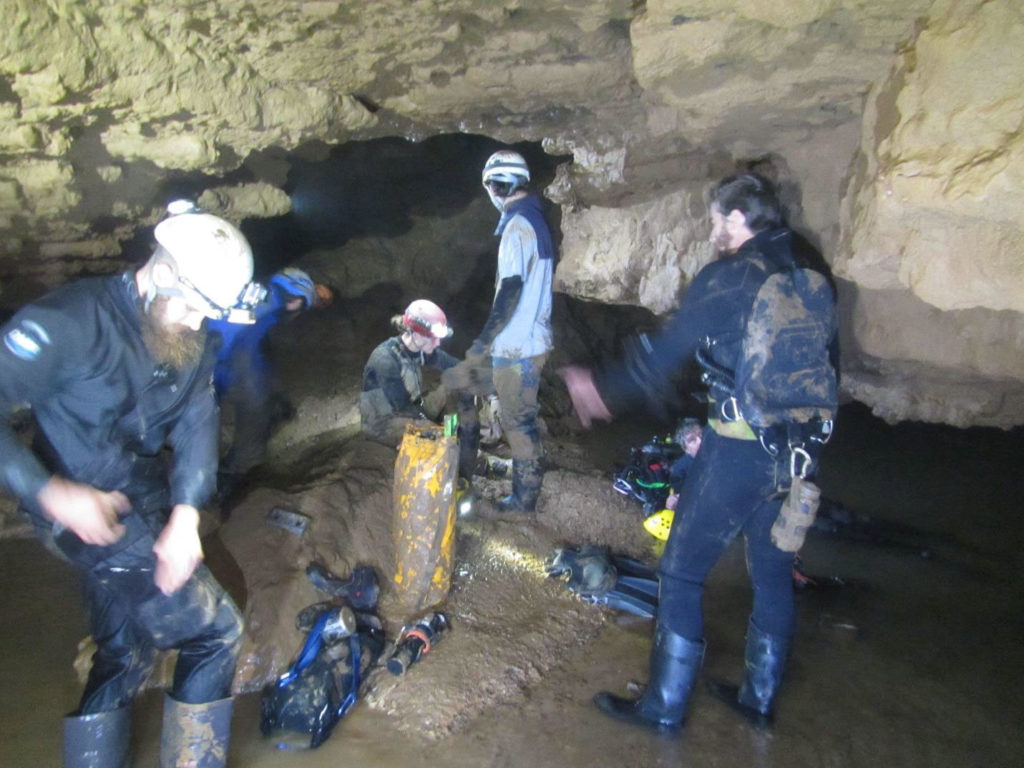
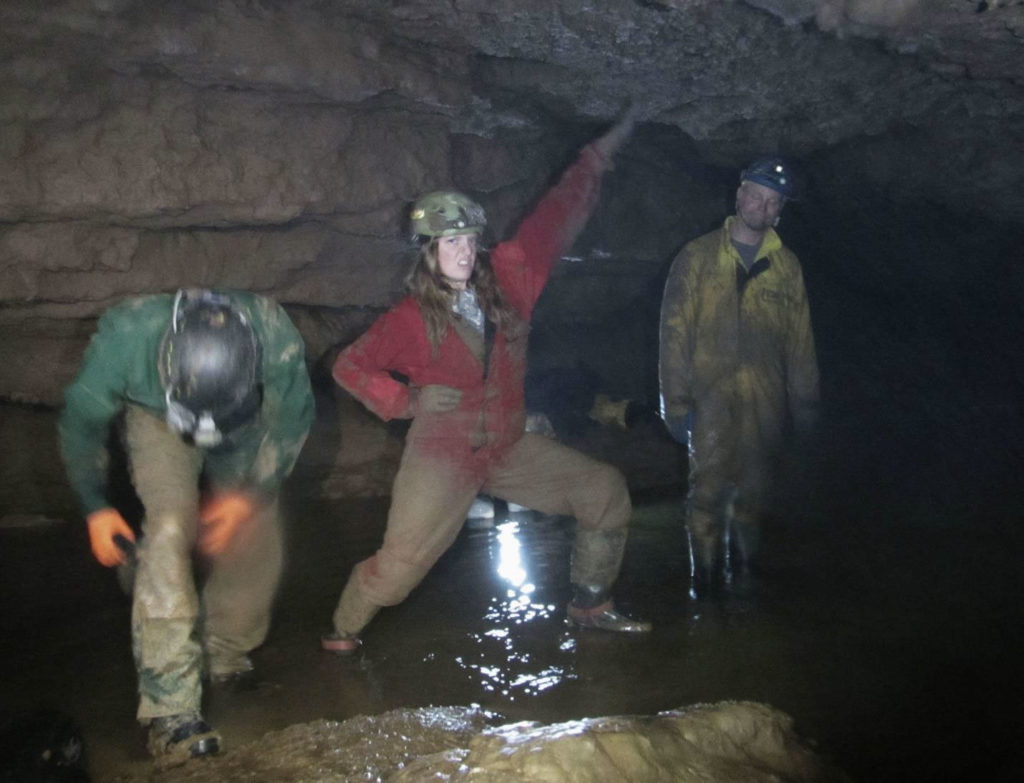
Support team and divers at “Crowbar Dome” prepare to move gear towards the Logsdon River sump.
Sometimes cave systems are connected via dry passage and sometimes by underwater passage. Either way, years of effort and exacting survey often produce the data needed to understand where the connections may lie. Sometimes its diligent caving and sometimes just lucky breaks. When Roppel cave was connected to Mammoth in 1983, Roppel itself was over 80 miles long but once connected to Mammoth it was removed from the worlds long cave list as it was now part of a larger Mammoth system.
So that brings us to the project we have been working on for over 10 years. The Logsdon River Sump in the Roppel Cave section of Mammoth cave. The first entrance to Roppel was discovered by Jim Borden in the early 1970’s and Roppel to Mammoth connection was made by a group of dedicated cavers that had been pushing exploration leads in both systems. Cave maps overlaid on topo maps showed the relative position and possible connection between the two systems. Through the combination of accurate survey and hard caving, connections are made, and exploration continues to reveal new passage.
Cavers have been working on connecting smaller caves to the Mammoth System since the early 1950’s. Many smaller caves were connected through concentrated efforts of survey and digging projects. Exploration and survey continues and is supported in part by the Cave Research Foundation, Central Kentucky Karst Collation and the National Park Service.
See the Article
See the full trip report.